This is my Midnight Guitar! I love it, but it took a long time to get it finished. The pickups can be changed in less than a minute and the case has a built-in amplifier. I want to share my process and how it all happened.
So, I had this old Kramer guitar. My friend Mo found it at the landfill one day and brought it to me (in 2014 or 15), because I love to fix things and all guitars should be playable and wonderful. The bridge had been partially torn out from the plywood body, which gave it a very high action. Here it is being used for a feedback composition at uni.
It sat for a long time occasionally being tortured with unusual tunings, but by 2024 the 16th fret had mysteriously disappeared, and the pickup selector had been replaced with Brian May style switching.
In late 2025, it was time to fix up the bridge so that it would fit properly. A little bit of work with a renovator and a chisel meant that a piece of aluminium angle could entirely replace the splintered plywood that the bridge originally mounted to. We can rebuild him!
While this was happening, I saw a video from Waylon McPherson about putting a contact mic on stratocaster springs for a fun little spring reverb. I started wondering if a conventional pickup would work instead. It fits! And it sounds awesome!
After that win, it struck me that I really wanted a guitar that could test new pickups. I wanted to be able to swap them out without having to mess with the strings. While carving out an appropriate cavity however, the kalimba became an intrusive thought!
A pickup route for the kalimba suddenly appeared!
I really like how the kalimba sounds! I used an earth bar and the keys from a broken kalimba.
After a long hunt around the garage for a good combination of materials, I settled on a combo of brass and acrylic, mostly scavenged from old workplaces. I like how the brass matches on the pickup holder, the Floyd Rose fine pitch knobs, and the kalimba.
The pickguard is mounted on hinges so that the pickups can be easily slid out from under the strings. The pickups themselves are mounted on their own acrylic pickup rings. These fit into a milled C channel at one end, and the other has a magnet on a standoff, which sits on a thin steel plate in the bottom of the control cavity. This means you can put the pickups just about wherever you like, but that they're also constrained just enough that they don't go for a walk when you shake the guitar.
This is how the pickup rings fit into the C channel. A layer of self-adhesive velcro is stuck into the bottom, which was then filed down till the acrylic jammed in nicely without coming free (but also not so tight that it couldn't be pulled out).
The pickup rings were filed out by hand so that the acrylic wouldn't shatter like the first two did. I love the chaos in this picture. It took two weeks of evenings, quietly working with the file and a good audiobook to get these all cut to size. I made enough for all the pickups I had lying around (I want to hear them!) plus a few extras.
A single output jack for the three main pickups, plus the spring pickup and the kalimba felt like a lot. What if I wanted to send some of them to different places? It turns out that double stratocaster output boats only existed in my imagination, so I dreamed one up with a piece of foam and a scalpel just to make it exist in the real world.
It took a bit of work to make a paper template, cut it up, mark it out on a brass sheet, and then cut and solder it all together.
Controlling the soldering temperature was quite difficult. Twice I had it almost finished, and then in the process of adding in the final brass triangle it would get too hot and all the solder joints would turn to liquid and the whole thing fell apart. Got it on the third try though!
Here we see the first mockup with all the switches installed and a full complement of pickups. At this point looking at the guitar just made me smile.
After a bit of play testing, it was clear that the cracks behind the neck were allowing it to flex too much. The holes from the locking nut meant that a lot of material had been removed from the thinnest part of the instrument.
Two plugs were fitted. One to fill the old holes from the locking nut, and the other to add a solid piece of wood grain across middle of the cracks. The cracks were levered open and filled with glue.
I'm very happy with the result. The plugs were made from an old drumstick (white oak), and after carving them down to meet the maple neck, sanding and clear coat (and more sanding), you can no longer feel the cracks or the plugs. The headstock is much stronger and no longer bends. Getting good enough with the chisel to pull this off feels like I have made a woodworking milestone, and every time this catches my eye I'm proud of it.
With all the problems amended and all the features decided upon, the guitar body was stripped of all hardware and sanded back to primer and plywood. The spring cavity was also extended so that the spring reverb could be stretched out and make a bit more sound. You can pass your arm right through the body!
A section was chiseled out on the back to make a holder for picks (why not test picks as well as pickups?). I really like the body contours on this guitar; they are very comfortable.
First coat of paint! I was very excited.
Really loving how it looks!
With the brass and acrylic on the deep blue, it was starting to look even more fantastic. Extending the control cavity into the lower arm looked a lot better when viewed through the pickguard. The deep blue on its own seemed to be missing something however.
With some neat lego pieces for inspiration, my wonderful Becca painted some stars! This is when it was first called the Midnight Guitar. She really brought out the dreamy, starry nature of the instrument.
Here is it slowly coming back together. Unfortunately, right after doing the second layer of cleat coat I dropped the body on the driveway and had to sand it back and repaint it a bit. A few remedial stars had to be added. I made a strap to match, using the suede side of the leather and some great orange seatbelt-style webbing from AliExpress. Doing the little M in the stitching on the bottom end was fun.
I really love how the clear coat came out! Totally smooth to the touch. The plate for the kalimba pickup was remade from the orange acrylic to match the rest of the look.
The locking nut was reattached with two small wood screws filed down to fit in the existing holes and screwed down into the new wood on the back of the neck. Much better than the gaping boreholes from the original nuts (and the glue someone had put in there to hold them in place). I also remade the truss rod cover from the orange acrylic, thicknessed down and repolished to fit under the string guide. The original string guide was steel, bent and rusty with black paint flaking off, so a new one was made from brass.
The neck and frets were polished up with some steel wool and then oiled every day for a week, polished before each coat. It's such a joy to play now. The tuning is CGCGCD (root, fifth, octave, upper fifth, upper octave, then one step down). I really love this tuning for this guitar! The kalimba is tuned to a sort of G minor scale, with the lowest note being the same pitch as the second-thickest string.
The three main pickups all join into some speaker connectors (you can see them through the pickguard). The pickguard also kind of holds each pickup down in place, and clicks firmly shut with a little stopper next to the bridge. Each of these three pickups has a slide switch that goes OFF/OUT OF PHASE/ON. Then they're summed together at the hexagonal volume knob (pull/push for 250k vs 500k, nice to try different pickups with). Then these go to the first output jack.
The spring pickup and the kalimba pickup go to the two lower switches (ON/OFF), then sum at the second volume knob. These go to the second output jack. The switch contact of the second output jack goes to the first jack however! This is so you can use all five pickups if you only want to use one guitar lead. If you plug in a lead to the second jack, then the spring and kalimba come only out of the second jack, so that you can send them to a different signal chain or amplifier. Hope that makes sense!
All the wiring is done with cloth/wax insulated and shielded wire, or with silicone-insulated wire. Some of the shielding was carefully expanded to add the silicone wires to it, so that it looked clean and tidy and benefited from the shielding. I wanted to avoid PVC-insulated wires as it can degrade over time and I want this instrument to last for a long time.
The control cavity was not shielded because it already looks great, the steel plate is shielded and the wires are shielded. The wiring was done very carefully over the course of a week of evenings and a weekend.
I'm so happy with it!!
But where will I keep it? The kalimba sticks off the bottom edge a bit, so it would get beaten up if I put it in a guitar bag. So it needs a hard case! I should make one! It can't be that hard....
Hard case! This outer case didn't actually take all that long, as it's mostly cutting and riveting. Maybe a week or so (evenings after dinner, few hours in the weekend). It's made from a sign for The Hits radio station which had an out-of-date logo on it. I only used half the sign, so 1200mm x 1200mm all up. It's made of ACM (Aluminium Composite Material) signage board. This is basically 0.5mm of aluminium skin on either side of a polyethylene core. The corners are made from some scrap aluminium angle I found, and it's just riveted together. Hinges were reclaimed as well. It's a nice material to work with; you can cut it with a craft knife and some determination.
Test fit. The foam surround piece is acoustic treatment foam left over from some studio builds, and just the right thickness. The small black case holds extra pickups and pickup rings.
If I have pickups to test and a guitar to test them in, all in the same box, then why not have an amplifier to test them? Why not mount it in the same case? Here you can see the speaker grille coming together.
I found these 60W mono amplifier boards on AliExpress, based on the TPA3118 amplifier chip. These are awesome because they take 8 to 24 volts. After hooking one up to my speakers, I was pleasantly surprised by how good it sounds, even with just the guitar going straight into it with no preamp. The speakers and crossover for this amp came from a small studio monitor. The whole amp runs off a Stanley drill battery.
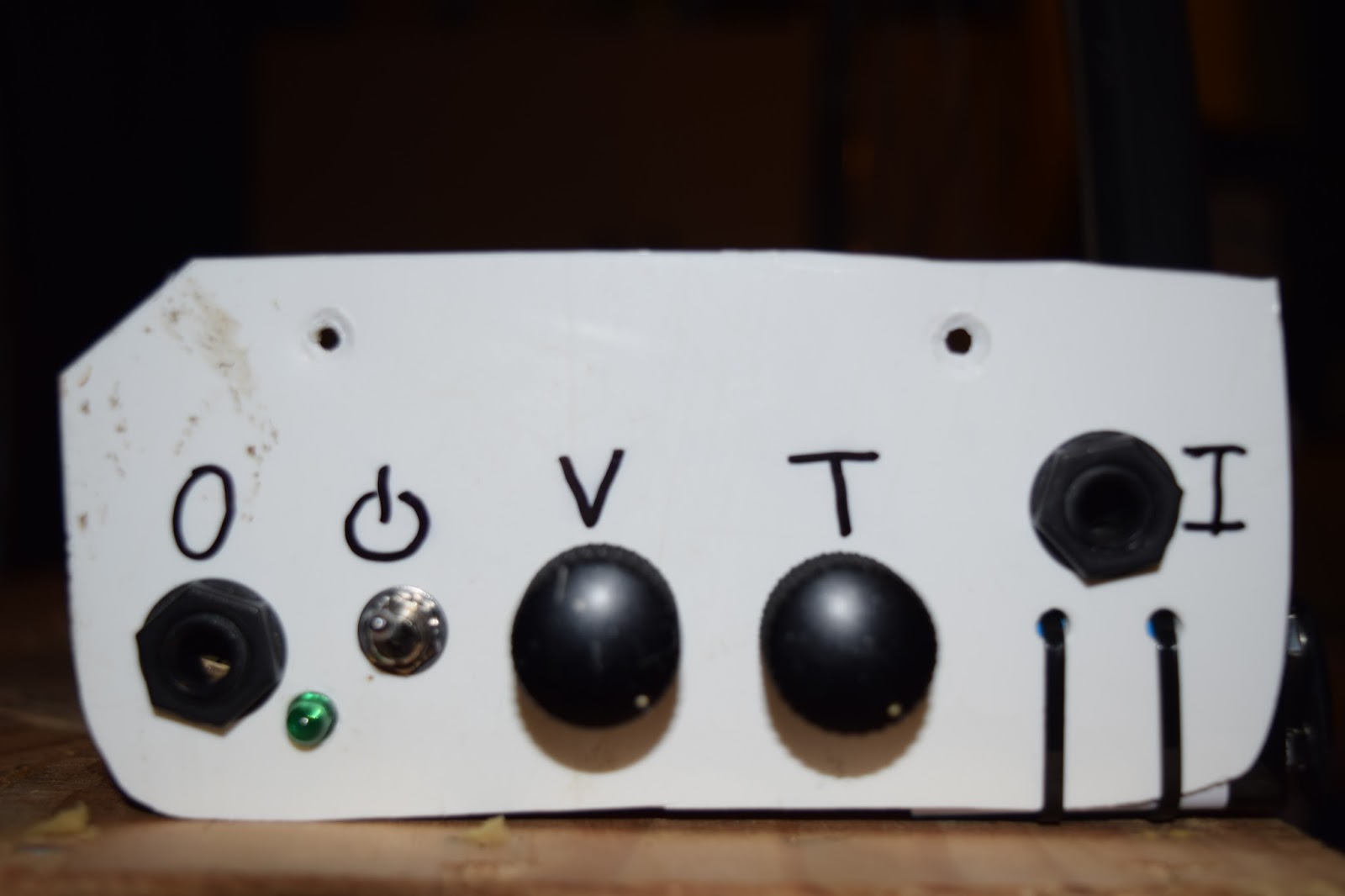
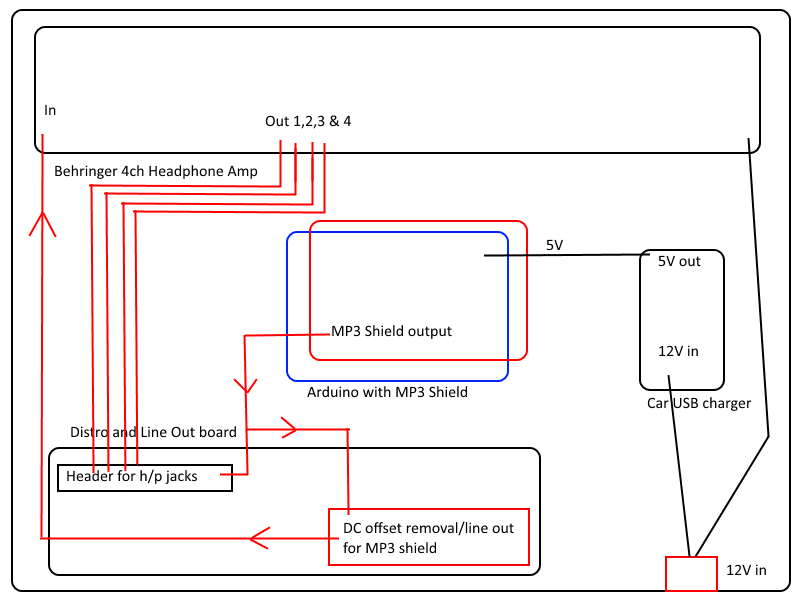
The amp is built all on the front plate. Two inputs go to two identical preamps, which are mixed together before going to the 60W amplifier board. There's a nice clunky on/off switch, a 9V regulator for the preamp (and barrel jack output for powering pedals), and a couple of fun hidden features.
I wanted to build the preamps from first principles rather than copying another schematic, by starting with an op-amp buffer and then increasing the gain to make it boost and distort. This was hard but lots of fun. Beavis Audio continues to be the most humbling and educational resource I've ever had for working on audio circuits. I always learn something new when I re-read his website every year or so.
The two preamps have their own gain controls and clipping diode switches. They go from clean and quiet to loud and biting, with lots of lovely distortion. I don't think I'm capable of making something loud and clean, everything seems to t̴̗̂u̷̻̒r̶͓̅n̶͖̓ ̷̯́t̵̜͠ȯ̸ͅ ̵̣͝d̶̺̀í̴͜ș̷̀ṫ̷͎ô̶̟r̶̬͌t̸̼̎ĭ̵ͅó̵̜n̵̯͑ ̶͍̽ä̴͖́r̴̖̀ò̶͚ũ̶̳n̵̢̈d̶̘͝ ̴͎́m̷͓̉ȇ̴̼. I was clever with the switched jacks so that if you plug only into input II, it bridges to input I and gives you the power of both.
A switch is mounted behind the LED so that if you push in the LED with your pinky, it bypasses the preamps completely. This can be handy if you want to try a different sound, like an amp-in-a-box kind of pedal.
Clipping diodes are LEDs. Everything mounting with standoffs to the front plate made it really easy to work on. The signal chain goes:
Guitar -> preamp -> 60W amp -> crossover -> speakers
The final little tweak is a Tweeter Defeater! Just a switch in line with the tweeter so you can disable it if the tone gets too harsh. This is hidden inside the port on the bottom side of the amplifier box, and you can reach in and flick it with a finger.
Amplifier finished! The fabric is a lovely cotton print from Pete's Emporium here in Porirua. The drill battery holder was homemade; it just slides along some bolt heads and clicks into a couple of homemade brass blade terminals.
The amp sounds SO LOUD and rich and distorted; I love it! The rest of the case still looked like this though. I needed a lining.
This purple felt suited the guitar nicely.
Here is my first attempt at pinning a curved seam ready for sewing. Big thank you to my Mum and to my sister Rachel for talking me through some good techniques for getting the lining together!
It turns out that two lego studs is basically perfect for marking a 16mm seam allowance.
Here is Skittles hanging out and keeping warm while I sew :)
This is after getting the bottom and the sides mostly sewn together. Pinning it every 20mm or so helped a lot. The sewing machine was great on the large corners, but the smaller one around the upper bout of the guitar had to be stitched by hand.
Here is the top plate attached. Not the best work but it fits and I'm proud of it!
The lining really beginning to come together.
The pocket for the headstock was quite fiddly to make, with lots of curves all hand-stitched. It's a different kind of joint when you're going from the bottom to the side, to when you're going from the side to the top. The orientation of the seam is different and I had to be careful with the tension.
Here you can see the back of the headstock pocket just after trimming the excess seam allowances off. You can see the seam where the ends of the side wall join together.
First test fit of the lower lining installed in the case. A strip along the front edge was also added to hold it all together and close off the gaps. I really like how well I got it to fit around the foam piece, despite it being my first time doing curved seams. It was a humbling experience, but I learned a lot! I only had to redo about a metre of screwed up seams.
Upper lining cut out, pocket is stitched in!
The pocket is basically the full width of the upper lining, and large enough to store two guitar leads, some power wires and a handful of patch cables.
My hand-stitched lines over the pocket flap turned out straighter than the ones I did on the sewing machine...
First test fit of the lining in the case. The upper lining is backed by some 10mm foam to give it a bit of cushioning, with the same in the lower case under the guitar. Super excited! But it does seem kind of bare...
So I bought some embroidery thread and started to add stars to the lining, so that the Midnight Guitar could sleep in a bed of stars. This white star with the blue edge took about two hours! I used a slightly metallic embroidery thread so that they would shimmer a little.
Upper lining now covered in many embroidered stars! They're all slightly different but I really like them.
Stars on the lower lining complete!! The embroidery of all the stars took about two weeks of evenings, just patiently working through each one of them.
VERY pleased with how it came out after some spray adhesive. I also embroidered my name, which was fun. It was at this point that I realised I had nothing to stop the case from opening too far, so I added the white string on the left (pull-start cord, rated for 200kg or so), using some rivnuts embedded in the sides of the case and then melting the knotted string into them so that it sits flush.
After doing all that embroidery on the case, the guitar strap seemed a bit bare. Seven stars soon appeared in a nice deep blue.
AND I GOT THEM TO LOOK THE SAME ON THE BACK!! This was a really fun challenge. And no, I'm not gonna replace that 16th fret; I'm kind of used to it now. It's weirdly easier to get to and if I need the note in between I can bend up to get there.
At this point, I closed the case and realised that the Hits logo wasn't much fun to look at so I rounded up some paint pens and hit it with the thorns design I've been doodling since high school. I did a couple layers of clear coat over the top to lock it in and protect it. I'm not gonna be too bothered if it gets scuffed up. It's mostly there to look cool and protect the guitar.
The buckles and handle were rescued from a crappy road case that was broken and destined for the landfill. I left the handle for last because I wanted to get it mounted exactly on the centre of gravity so that it would be easy to carry. It turned out that between the weight of the amplifier and of the guitar body, the centre of gravity was exactly in the middle! A happy accident.
The one downside to using reclaimed materials instead of getting the right stuff is that it's a little heavier than it needed to be. 20KG is fine for me, but it can be a bit much for some people. If I was commercially developing a case I would be redesigning it to get the weight down (ideally less than the guitar itself), but this one-off is fine by me, and it also has the amplifier and looks awesome.
Top side painted! If you look closely you can see the rivets that hold the amplifier into the top.
The feet on the bottom and the back edge are just bolts and washers. Hard wearing and easily replaceable.
This is the little case that holds extra pickups and pickup rings. Schematics for the guitar wiring and the amplifier design are kept in the lid.
Lots of cable storage! The guitar leads are homemade as well. You can buy component video cables (RGB) at op-shops and put 1/4" jacks on them to make colourful guitar leads.
Here is the guitar in the wild, on top of Wharite Peak near Palmerston North. It was lovely to play guitar on a mountaintop after spending a day pulling cables through the radio transmitter site.
Midnight Guitar complete!
It took about eight or nine months, but I was also doing other side projects and things. I don't think I could have made it any quicker as ideas can only flow so fast. Taking my time with it meant that I cut no corners, and that I spent plenty of time learning to do new things. This isn't my first time making audio circuits but I've never put together a whole amplifier before. This also wasn't my first time sewing, but my precision and hand stitching had to get a lot better to make the lining work, and learning how to embroider has been really fun. I learned a lot of things.
Total cost of the project is hard to calculate but it's very low. The guitar was a gift (bit broken), the case is mostly reclaimed material. The amplifier board was about $7, and the various fabrics and threads cost about $60. Clear coat for the guitar would have been about $50. Spray adhesive was $18 I think. This is in NZD. Pretty much everything else was reclaimed, surplus or I already had it on hand for various reasons.
Happy to share more if you have questions! I'm mostly just glad to have this finished, and it's been a huge part of my life recently.
Hope you enjoyed reading about it! At some point I should do a video to show you how it sounds.
-Morgan